
Introduction
The team at the Royal Archives have selected material according to the themes set by The Archives and Records Association for the 2025 campaign. We hope that these unique and rarely-seen items help you understand more about the work of the Archives and the documents they preserve, as well as the history and work of the Royal Family.

Supplied by the Royal Archives | © His Majesty King Charles III 2024
Day One: Conservation
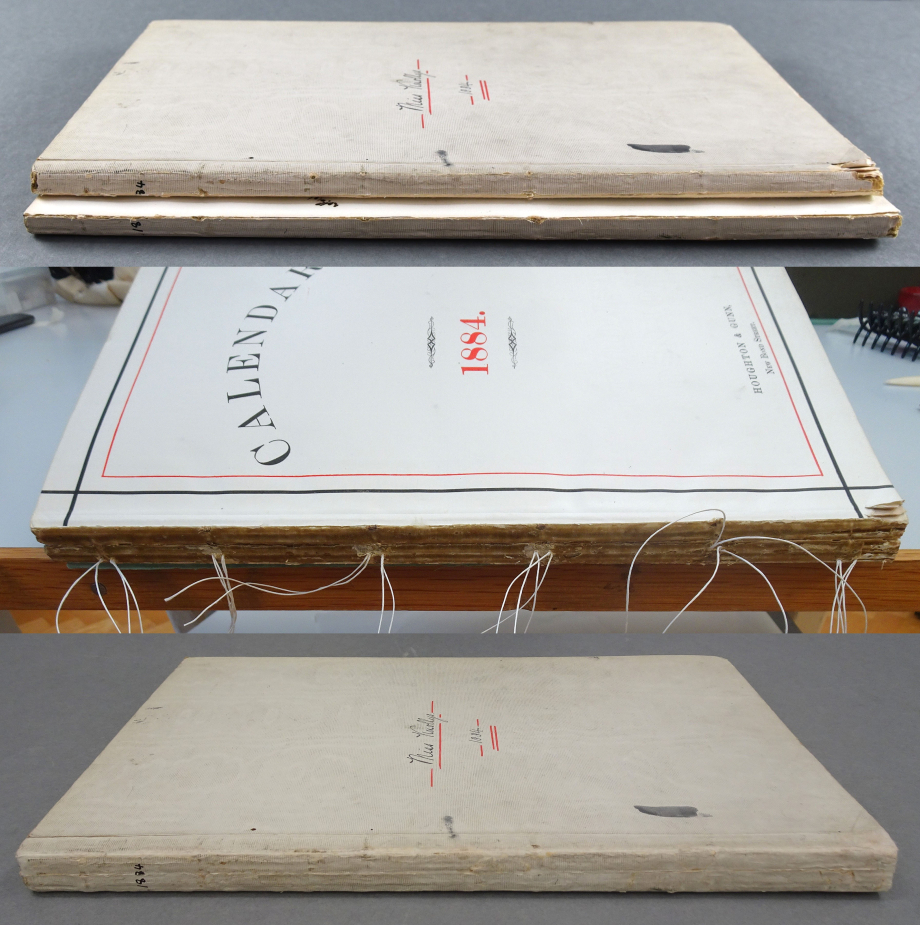
The Royal Archives holds several of Queen Alexandra’s Engagement Diaries, covering the period 1873 –1925. These printed ‘Kalendars’ were kept for the Queen by her Lady-in-Waiting, Charlotte Knollys, and contain brief handwritten entries divided into morning and evening.
Unfortunately, over the years the volume for 1884 has become damaged and therefore required conservation. The below images showcase the excellent work of the Royal Bindery Team in repairing the diary. This volume, along with the other of Queen Alexandra’s engagement diaries have been scanned and are available to view online.
Supplied by the Royal Archives | © His Majesty King Charles III 2024
Day Two: Beauty
This beautiful Art Nouveau-style electro-silver binding, mounted on dark blue velvet, was designed by Miss M. Lilian Simpson as a commission for the Art Union of London. Her design won a gold medal in 1894 in a national competition held by the Government for all the Schools of Art.
The original design was subsequently exhibited at the Royal Academy in 1896, and several copies were produced, including this one, which was bought by the then Prince of Wales (the future King Edward VII) and later given by him to his wife, Queen Alexandra, as a Christmas present in 1905. The Queen used her volume as a visitors’ book, and it contains the signatures of many relations and friends. Other copies of the binding are in the collections of the British Library and the V&A Museum.

Supplied by the Royal Archives | © His Majesty King Charles III 2024
Day Three: Medieval
This manuscript was purchased by King George V in 1911 and is the oldest document in the Royal Archives. Written in Norman French, it lists jewels from the Wardrobe of King Edward I which were handed over to Walter de Morselede in September 1297.
The records held within the Royal Archives predominantly start with the reign of King George III (1760-1820), with those from earlier reigns stored at The National Archives, London, so this document is something of a rarity within the Collection.

Supplied by the Royal Archives | © His Majesty King Charles III 2024
Day Four: Silence
On the 11 November 1920, King George V unveiled the Cenotaph (the National Memorial to the 'Glorious Dead'), which was followed by a two-minute silence. Queen Mary wrote in her diary that the silence “had a wonderful effect”. Afterwards, Their Majesties attended the burial service for the 'Unknown Warrior' in Westminster Abbey.
King George V reflects in his diary on this affecting occasion:
…Today I unveiled the Cenotaph in memory of the "Glorious Dead" in Whitehall & was Chief Mourner at the burial of an "Unknown Warrior" in Westminster Abbey. At 10.15 we all motored to the Home Office, the Ladies went to windows, I with the three boys received the body at the Cenotaph, which had been brought from France yesterday & the funeral procession came from Victoria station. At 11.0. I unveiled the Cenotaph & then followed two minutes silence throughout the Empire. The whole ceremony was most moving & impressive. I then followed the gun carriage on foot to Westminster Abbey where the burial took place, the grave was filled in with soil brought from France. The Service was beautiful & conducted by the Dean. All the Ministers headed by the Prime Minister & Mr Asquith walked in the procession beside a large number of representatives of the three Services. Got home at 12.0. everything was most beautifully arranged & carried out…

Supplied by the Royal Archives | © His Majesty King Charles III 2024
Day Five: Pets

Supplied by the Royal Archives | © His Majesty King Charles III 2024
During her life, Queen Victoria had many dogs from a variety of breeds and of all shapes and sizes. This volume contains a list of dogs which were housed in the Home Park Kennels at Windsor Castle in 1893. The page shown concerns one of Queen Victoria’s collies, Darnley II, who won various prizes at Crufts in 1891.
Day Six: Digital
Queen Victoria began writing a Journal in 1832, when she was 13 years old. Although this began as an educational exercise, it clearly became a pleasure for her, and from that time onwards she wrote her Journal almost every day, with only a few short breaks when she was ill, until shortly before her death in 1901. The image below shows the opening page of her first Journal, in which she writes “This book, Mama gave me, that I might write the journal of my journey to Wales in it”.
The Royal Archives, in partnership with the Bodleian Libraries and ProQuest, has made Queen Victoria’s Journals available to view online. This unique digitised resource was launched by Her late Majesty Queen Elizabeth II on 24 May 2012, the anniversary of Queen Victoria’s birthday. At present, Queen Victoria’s Journals website is available free to users in the United Kingdom, and via overseas institutions that have a subscription to the site.

Supplied by the Royal Archives | © His Majesty King Charles III 2024
Day Seven: Inclusion
Charlotte Heidenreich von Siebold, unusually for a woman in the early 19th century, was a formally trained physician who specialised in women’s health, taught midwives and advocated for better conditions for poor women during childbirth.
Von Siebold delivered Princess Alexandrina Victoria of Kent (the future Queen Victoria) at Kensington Palace on the 24 May 1819.
The page shown is from a letter, written by Prince Edward, Duke of Kent (Queen Victoria’s father) on 5 April 1819, in which the Duke writes that his mother-in-law, the Duchess of Saxe-Coburg-Saalfeld “…has great confidence [in von Siebold], both as a physician and surgeon for which she regularly studied, as a man, for years at the University of Göttingen, and as a Midwife, in which capacity she attended the Reigning Duchess of Saxe Coburg in August last to the entire satisfaction of the family...”
A few months later, Von Siebold also delivered Prince Albert (later Prince Albert, Prince Consort).
In August 1845, while they were in Coburg, Queen Victoria and Prince Albert met von Siebold, with the Queen remarking in her Journal that “…we saw Mme Heidenreich, who is a real Physician & who attended Mama when I was born, & Albert’s Mother when he was born, which is a very curious circumstance…”

Day Eight: Anniversaries
King George V describes in his diary the celebration of his Silver Jubilee on 6 May 1935. That evening, the King broadcast to the Empire, ending his speech: “Let me end my words to you with those which Queen Victoria used after her Diamond Jubilee, thirty-eight years ago. No words could more truly or simply express my own deep feeling now: ‘From my heart I thank my beloved people. May God bless them’”.
“A never to be forgotten day, when we celebrated our Silver Jubilee. It was a glorious summer’s day 75º in the shade. The greatest number of people in the streets that I have ever seen in my life, the enthusiasm was indeed most touching. May & I drove alone with six greys, there were 5 other carriages in our procession. The thanksgiving Service in St. Paul’s Cathedral was very fine. 4,406 people present. Everything went without a hitch. Streets lined by troops, which were beautifully decorated. On our return we went out on the centre balcony & were cheered in an enormous crowd… At 8.0. I broadcast a message of thanks to the Empire. After dinner we went out on the balcony again & there must have been 100,000 people round the statue & down the Mall.”

Supplied by the Royal Archives | © His Majesty King Charles III 2024